



Search visibility used to mean one thing: where a page landed in ten blue links. That definition stopped being enough the moment ChatGPT, Perplexity, and Google’s AI Overviews started answering questions directly, which is exactly why AI search tracking software tools exist now as a separate category from traditional rank trackers. Being mentioned inside an AI-generated answer carries real weight for trade businesses competing on branded and service queries, yet most marketing teams have no reliable way to measure how often that happens.
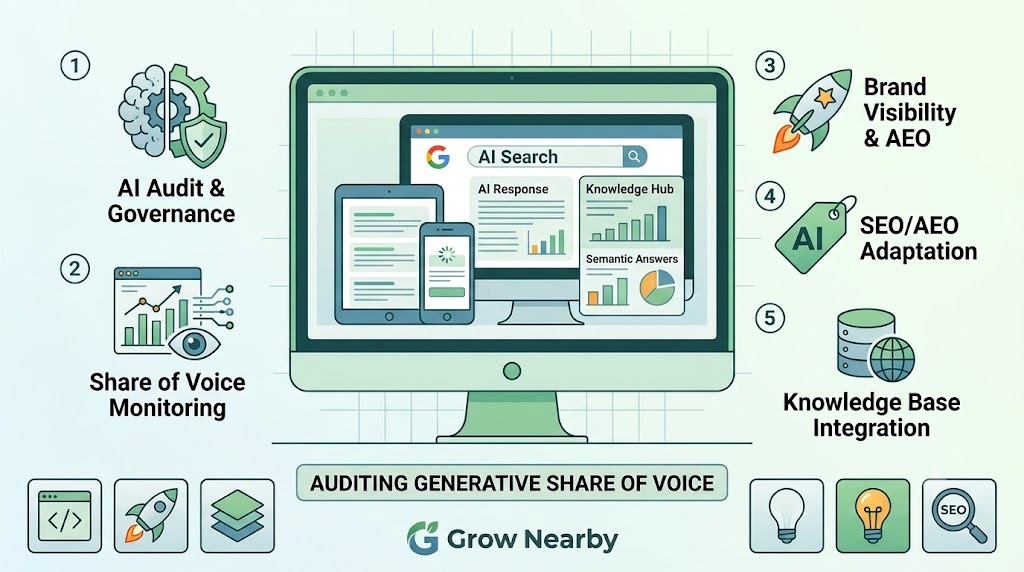
Traditional SEO platforms were built to track blue-link positions, not citation frequency inside a generative response, which leaves a measurement gap most agencies are still figuring out how to close. This piece walks through five categories of platforms built specifically to audit generative share of voice, along with what each one does well and where it still falls short. None of these tools is perfect yet, since the entire category is barely a couple of years old and still catching up to how fast the underlying engines keep changing.
Tracking Your Digital Brand Footprint Across Generative Search Engines
Dedicated Generative Visibility Trackers
A newer wave of standalone platforms exists purely to track how often a brand or its competitors show up inside AI-generated answers across multiple engines at once. These tools run a set list of prompts on a schedule and log which sources get cited, quoted, or paraphrased in each response. Some go further and break results down by engine, so a team can see whether visibility differs sharply between ChatGPT, Perplexity, and Gemini for the same query set.
The strongest platforms in this category also track sentiment, flagging when a brand gets mentioned in a negative or comparison-heavy context rather than a favorable one. Pricing tends to scale with prompt volume, so smaller trade businesses often start with a narrow prompt list focused on their highest-value services. Expanding that list later is usually simple, though the real cost driver tends to be how many engines get tracked at once rather than the prompt count itself. Is your trade brand practically invisible inside AI Overviews and conversational engines? Secure your digital presence with our dedicated Answer Engine Optimization Services and start capturing modern search citations.
Enterprise SEO Suites With AI Search Modules
Several established SEO platforms have added generative tracking as a bolt-on module rather than building a separate product from scratch. For teams already paying for enterprise rank tracking, monitoring rankings in ChatGPT search through the same dashboard cuts down on tool sprawl and duplicate reporting.
The tradeoff is depth, since these bolt-on modules rarely match the prompt customization or citation granularity that dedicated tools offer. Existing integrations mean reporting templates and client dashboards usually need minimal rebuilding once the module gets turned on. Agencies managing several trade clients at once tend to lean on this option first simply because it lives inside a tool the team already knows. Don’t let national directory aggregators hide your individual service branches. Partner with Grow Nearby for data-driven Local SEO Plans tailored explicitly for expanding contractor operations.
Prompt-Based Share of Voice Auditing Tools
A different category skips broad tracking entirely and instead builds around a fixed set of prompts a client cares about most, like specific service and location combinations. These generative engine visibility audit tools run the same prompt list on a repeating cadence and track exactly how the answer changes over time, not just whether a brand appears. That consistency makes it easier to correlate a content change or new schema rollout with a shift in how often a brand gets cited.
Smaller trade businesses often prefer this approach since it avoids paying for broad monitoring across queries that never mattered to their market anyway. The tradeoff is coverage, since a narrow prompt list can miss emerging queries that a broader tool would have caught early. Teams that go this route tend to review and refresh their prompt list every quarter to keep pace with how customers actually phrase new questions.
Local-Focused AI Visibility Trackers
A newer, smaller group of platforms builds specifically around local and multi-location service businesses rather than national brands.
What sets these apart:
- Location-specific prompt sets: Queries get built around city and service combinations instead of generic brand terms.
- Cross-branch comparisons: Running local share of voice analytics across neighboring service areas matters for franchise and multi-branch trade companies competing internally as much as externally.
- Competitor overlap reports: Some platforms flag which competing businesses get cited most often for the same local prompt set.
For a company running several branches across one metro area, this category tends to surface problems a national tool would miss entirely.
Custom Prompt Monitoring Dashboards
The most flexible option for agencies is building a custom dashboard that pulls citation data through available APIs and displays it as the client’s reporting actually needs. This route takes real setup time and some technical resources, but it avoids paying for features a client will never use. Custom builds also make it easier to layer generative visibility data next to traditional rankings, reviews, and conversion numbers in one unified view.
The downside is maintenance, since API access and formatting for each AI engine tends to shift without much warning. Agencies with in-house development resources increasingly lean this way once client volume justifies the build cost. Smaller shops without that overhead usually start with an off-the-shelf tool and only move to a custom build once the reporting needs outgrow what a template dashboard can show.
Conclusion
Generative share of voice is still a young measurement category, and no single platform covers every engine and use case perfectly yet. Choosing between a dedicated tracker, a bolt-on enterprise module, a prompt-based auditor, a local-focused tool, or a custom dashboard usually depends on budget, technical resources, and how many locations need coverage. What matters most is picking a method and tracking it consistently, since sporadic checks make it nearly impossible to tell whether a content or schema change actually moved the needle.
Trade businesses running multiple branches especially benefit from tools built with local nuance in mind rather than a one-size-fits-all national dashboard. Whichever option gets chosen, treating generative visibility as a real metric instead of an afterthought is quickly becoming table stakes. Waiting another year to start tracking it just means starting from further behind once every competitor already has a baseline. Grow Nearby tracks how often your business shows up in AI answers, not just search rankings. Contact us today.
FAQs
Ques: Can small trade businesses in Chicago, Illinois, afford AI search monitoring tools?
Ans: Several platforms offer scaled-down pricing tiers built around a narrow prompt list, so a single-location trade business in Chicago, Illinois, can track a handful of high-value queries without paying enterprise rates.
Ques: How is AI search visibility different from regular rankings for a business in Chicago, Illinois?
Ans: Traditional rankings measure position in a list of links, while AI search visibility measures whether a business in Chicago, Illinois, actually gets cited or quoted inside a generated answer, which is a fundamentally different signal.
Ques: Should a marketing team in Chicago, Illinois, track every AI engine or just one?
Ans: Most teams start narrow and expand, since a trade business in Chicago, Illinois, typically sees the clearest early signal from tracking just one or two of the most-used engines before scaling monitoring further.